Nice Dark Eggs

My January Black Copper Marans pullets have started laying, and I am really pleased with their egg colour. I hatched only the darkest eggs, and my rooster is from good dark egg lines. Looks like the selective breeding is paying off.

IMG_6156

My same age Olive Eggers are just at point of lay too, I can’t wait to see what shades of olive eggs they lay.

IMG_6157

The Big Clean

I am happy to be at the tail end of this weekend, and absolutely knackered too, because this year, I deep cleaned all three coops in a single go. Vacuumed, scraped, scrubbed, power washed, swept, tore out, repaired, refreshed, redesigned and redid; it all got done this weekend.

I like to do my annual deep clean in July, after we have had a bit of heat, because that’s what brings on the mites, and I want to hit those little suckers when it counts. The summer after my first full year keeping chickens, I was unpleasantly surprised by a bad red mite infestation. It was a relief to not find a single mite this year, as I disassembled roosts and pulled nestbox assemblies, to take them outside to scrub. The year round wood ash/peat moss/sand dust baths are helping my birds keep themselves pest-free. The layer of diatomaceous earth under each nest, where my girls can’t breathe it in, is helping too. There was lots of dust and dander, cobwebs and feathers, and of course chicken poo galore, but no pest problems.


I am pretty happy with the new roost layout in the cedar coop, increased from 18 to 24 linear feet all on the same level. (Gasp! room for more chickens?) I replaced V3 broody box with version 4 – this one folds up out of the way against the wall when not in use, and the middle roost is easily removable with its drop in design. It will be easier to clean in there this year.

IMG_6153

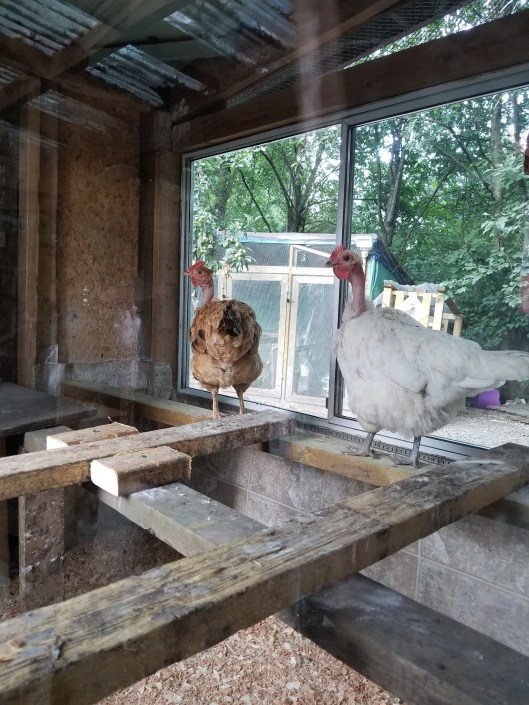
Of course it was Becky the B (the white, green legged girl, who spends her days outwitting K’s garden defences) and her sister buff Turken who checked out the new digs first. Chickens are curious, and the smarter they are, the curiouser. 🐓


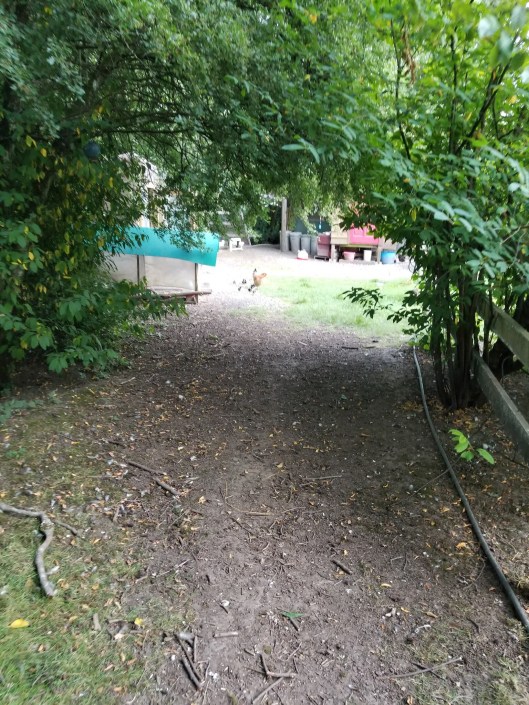
Exploring the Barnyard

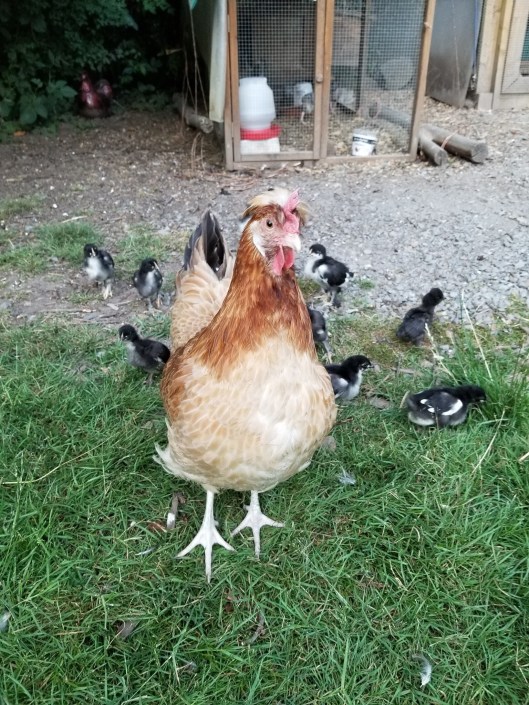
Alsty took her latest brood out for their first wander this evening. Peeping excitedly amongst themselves, the kids darted here and there, never going too far from mama. Alsty kept up a running commentary too, pointing out choice morsels, issuing warnings, and clucking reassuredly to chivvy the timid ones along.

After all that excitement, I’m sure they will sleep well tonight.

IMG_6143IMG_6144IMG_6145

June Harvest

This week, I am freezing raspberries, chicken, garlic scrapes, plus K froze kale. We are picking strawberries and peas too. Yay June!

My Wyandotte Project

I always wanted to try Wyandottes, but after my sister got two Silver Laced Wyandotte chicks who grew up scrawny and mean and laid small eggs, I wasn’t so sure.

After my research turned up a real mix of opinions on the breed, I realized that there were both good and bad lines out there. Some people breed for temperament and some don’t care. I just had to find some good ones.

Then last summer, I hatched a single spectacular Blue Laced Red Wyandotte pullet, who grew up all curves, ample and round and gloriously beautiful; docile, quiet and a good layer. Now I really wanted MORE.

So this spring I ordered three batches of eggs from breeders in BC, Alberta and Quebec, and hatched out 21 chicks in all, silver, gold and blue laced red.

My Wyandotte chicks now range in age from ten to 15 weeks, it’s easy to tell the girls from the boys, and their feathering patterns are clear (and diverse!) It’s time to select a cockerel or two, and five or six pullets, and sell off the rest. I must choose well, only the best birds should be kept for breeding.

The more I study, the clearer I can see which birds I should keep. What am I studying? The American Poultry Association’s Standard of Perfection, of course. 1920 version, online thanks to the Cornell University Library.  Updated every five years since 1874, the SOP is the authoritative source for “a complete description of all recognized varieties of fowls.” And it doesn’t go out of date, it just gets bigger and more detailed. The SOP for Wyandottes hasn’t significantly altered in more than a hundred years!


How’s the shape? Is she set low, short-backed and short tailed or all elbows and knees with a hollow comb and squirrel tail? Short, arched neck and wide crown? Deep, round, broad breast? How’s the temperament? Is he gentle and kind or pushy and mean? What about vigour? Does she move smoothly, jump easily, keep up with the rest? Is he heavy for his size, solid and athletic? And the plumage. Is it abundant and glossy? Are his hackle and saddle feathers silvery with black lines through each feather? And his breast, are the feathers well laced and even?  Tail feathers short, curved, fluffy and black with green iridescence?  Two rows of lacing on his wings? Orange eyes? Yellow legs? Slate undercarriage? And what about the underlying genetics? Why are all my silvers male? Sex linked colour genes of course! Now how does that all work? Do I keep a silver and a gold cockerel? Or a GL blue? Do my gold cockerels from breeder 1 have the most recessive genotype, so next year I can hatch all the colours? Decisions, decisions.

Some folks hatch hundreds to choose a few specimens to breed. Some folks study chicken confirmation for years and years. I don’t have the room for hundreds, and I am at the five year mark for chicken expertise; my little chicken hobby is humble in comparison. But it absorbs me, it keeps me thinking and active, and it chases away stress. I am having a ton of fun with my Wyandotte project, and for me that’s the whole point.


Puppy Sitting

Our three kids were away this weekend at a music festival, so we puppy sat. Chance the dog-crazy dog was delighted to hang with his two favourite gals, Liza and Mocha, all weekend. Liza was much less thrilled, especially when Chance and Mocha wrestled, but both bitches behaved better than when their owners are near.

Ironic, isn’t it, that the mature Lassie look-a-like is the one with the attitude problem, not the Staffordshire Terrier puppy!

The high point of the evening was, as always, chew chew time. Lucky for them we have treat-stuffed bones for three!


Hatch Day for Alsty

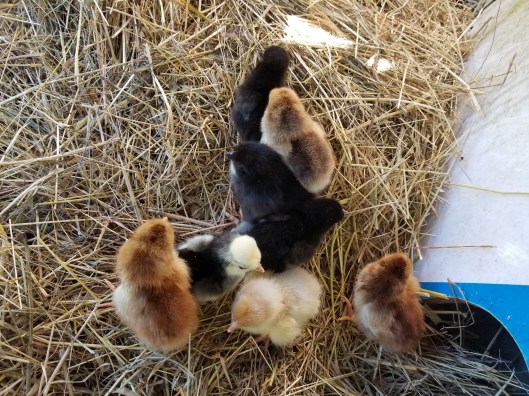
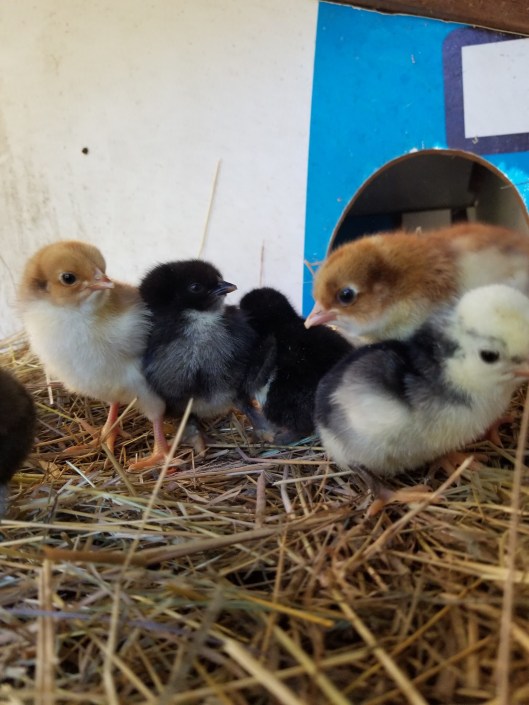
Alsty did it again. Four Swedish Flowers, two Polish, and two Hoppy babies! I knew I could trust good old Alsty. Tonight at dusk I will tiptoe out to her brooding pen with a bucket of nine. Nine more chicks that is…eight Black Copper Marans and one Hoppy baby. The last incubator-hatched chicks of the 2017 season. Alsty can handle 17 just fine. She mothered 18 last time.

And then guess what? For the first time since January 1st, no chicks in the house!

It will be nice to take a break, and enjoy watching the young ones grow up. The coops are overcrowded, but everyone free ranges most of the day, all over half an acre of field, and tree-lined creek, and wood chip paddock, and horse barn; so it doesn’t matter. There are plenty of night perches, and by the time the cold wet weather keeps the flocks under cover, I will have chosen next year’s breeders and layers, and sold off the rest.

I’m glad I decided to hatch a few Hoppy eggs. She’s no fancy purebred, but she is the most indomitable chicken I know. With three chicks, I should get at least one girl. Hopefully she will take after her momma.

IMG_6117IMG_6118IMG_6120IMG_6119


Meet David Cassidy!

This gorgeous young Swede has a whole flock of admiring young females, and some of the older ladies think he’s pretty hot too. On the petite side, like all Swedish Flower Hens, David may not be the beefiest man in the barnyard but the girls don’t care. They’re in love with his big brown eyes, his suggestive swagger, and his long shiny feathers.

Ffff

ffff

First Taste of Free Ranging

The gold, silver and blue laced wyandotte teenagers got their freedom today. Most of the pullets and the very youngest cockerels stayed home and basked in the sun. But for the brave boys (and couple of brave girls) who ventured outside, it was a VERY exciting day. They darted here and there in little gangs, sampling the new green grass, and leaves, and bugs, and gazing all around at the world they were suddenly in, instead of watching through a chicken wire door.

It was blustery, and each big gust sent alarmed birds barrelling back home for a few minutes of comfort before out they’d dart again. As dusk came on – every chicken’s curfew – they all went home to roost, and sleep well I’m sure. Dreaming of sunny, windy, green grass and bug filled afternoons.